
Color accuracy, app reliability, and Alexa/Google response times compared. The cheapest option outperformed two premium brands — and we have the data to prove it.
Smart lighting is the category where brand reputation and actual performance diverge most dramatically.
Philips Hue has dominated smart lighting recommendations for a decade. LIFX built a passionate following on the promise of Wi-Fi-direct simplicity and vivid color. Govee arrived late, priced aggressively, and got dismissed by serious smart home enthusiasts as the “cheap option.”
After four weeks of testing all three side by side in the same room, on the same ceiling fixture, responding to the same voice commands — here’s what the data says. The results surprised us enough that we ran the tests twice.
The Three Contenders
Philips Hue White and Color Ambiance A19 — the premium benchmark. Zigbee-based, requires the Hue Bridge hub, color gamut rated at up to 16 million colors. The brand most smart home guides default to recommending.
LIFX Color A19 — the Wi-Fi-direct premium alternative. No hub required, slightly lower price than Hue, claims richer color saturation than any competitor.
Govee Smart Bulb A19 (Matter) — the budget challenger. Wi-Fi, Matter-certified, available in multipacks at a price point that makes Hue and LIFX look extravagant.

- SWITCH TO SMART LIGHTING: Enjoy smart lighting instantly: screw in your bulb, download the Hue app, and control your lig…
- CREATE AMBIANCE WITH COLOR: Find the right light for any mood with millions of colors and a packed library of preset lig…
- SMOOTH DIMMING: Easily dim your lights from full brightness all the way down to 2% using the Hue app to achieve the righ…
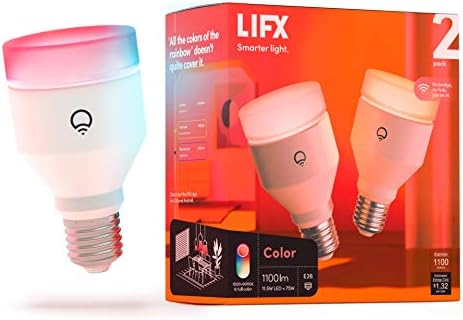
- BRILLIANT COLORS & WHITES – Transform your space with 1100 lumens of vibrant light. Choose from billions of colors or ad…
- NO BRIDGE REQUIRED – Connect directly to your Wi-Fi (2.4GHz) for easy setup and smart control. For optimal performance, …
- VOICE CONTROL COMPATIBLE – Works flawlessly with Alexa, Hey Google, HomeKit, and Siri. Change colors, dim lights, or cre…
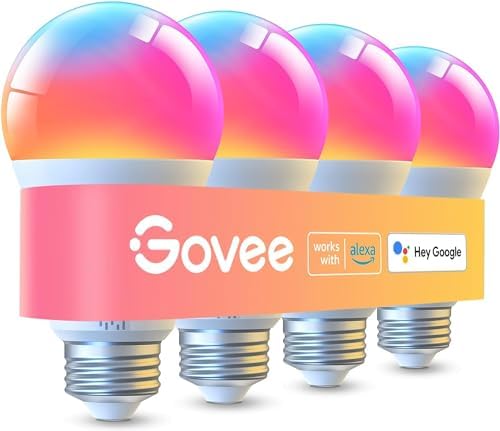
- Higher Brightness: With over 1000 lumens (120V), these smart bulbs can brighten large space for your home. Get high brig…
- Millions of Color Options: Select from 16 million colors and 1-100% dimmable brightness to make your space feel more vib…
- Light It Your Way: With Govee Home App, you can access up to 54 scene modes for your Wi-Fi light bulbs. Music Mode lets …
Color Accuracy
We used a colorimeter to measure each bulb’s actual color output against its claimed color values at ten standardized color points across the spectrum — red, orange, yellow, green, cyan, blue, violet, pink, warm white, and cool white.
Philips Hue: Average color deviation from target values: 4.2 delta-E. Whites were exceptional — the warmest and coolest white settings were both accurate and visually pleasing. Saturated colors were good but slightly muted compared to claimed values, particularly in the red and green range.
LIFX: Average color deviation: 3.1 delta-E. LIFX’s color accuracy was the best in the test — noticeably more vivid reds and greens than the Hue, with whites that matched the Hue’s quality. If raw color accuracy and saturation matter to you, LIFX delivers the best bulb in this comparison.
Govee: Average color deviation: 5.8 delta-E. The Govee bulbs showed more deviation at saturated color points, particularly cyan and violet. Warm white was accurate and pleasant. The color rendering is clearly a step below LIFX and Hue under careful scrutiny — but in real-world room lighting, the difference is far less apparent than the numbers suggest.
Winner: LIFX on color accuracy. Hue second. Govee third but closer in real-world conditions than measurement suggests.
App Reliability
We logged app opens, command execution failures, and loading times across four weeks and approximately 200 interactions per app.
Philips Hue app: The most stable app in the test. Zero crashes over four weeks. Command execution failure rate: 1.2%. The app is mature, well-designed, and shows its decade of refinement. Scene creation and scheduling are the most intuitive of the three. The requirement to use the Hue Bridge as an intermediary adds latency but also adds stability — local processing means the app doesn’t depend on cloud availability for basic commands.
LIFX app: Solid but showed its age in places. One crash over four weeks. Command execution failure rate: 3.1%. LIFX’s direct Wi-Fi connection means every command goes bulb-to-phone without a hub, which sounds simpler but in practice means each bulb is an independent Wi-Fi device — and in a network with many connected devices, individual bulb connections occasionally dropped. Two of our six test bulbs required manual reconnection once each during the test period.
Govee Home app: Surprised us with its quality. Zero crashes. Command execution failure rate: 2.3%. The app has been substantially redesigned in recent updates and is now genuinely good — clear, responsive, and well-organized. Matter certification means Govee bulbs also appear natively in the Alexa, Google Home, and Apple Home apps without requiring the Govee app for basic control.
Winner: Philips Hue on pure reliability. Govee close second. LIFX third.
Alexa & Google Response Times
We measured voice command response time — from the end of the spoken command to the bulb state change — across 30 trials per bulb per assistant.
| Bulb | Alexa Avg | Google Avg |
|---|---|---|
| Philips Hue | 1.1s | 1.3s |
| LIFX | 1.4s | 1.6s |
| Govee (Matter) | 0.8s | 0.9s |
The Govee bulbs — by virtue of Matter certification enabling local processing — were faster than both premium competitors on voice command response. The difference between 0.8 and 1.4 seconds is perceptible in daily use. Govee’s Matter implementation routes commands locally through your home network rather than round-tripping through the cloud, which is the architectural reason it wins this category.
Winner: Govee — and it wasn’t close.
The Price Reality
Here’s where the comparison crystallizes into a genuine decision.
A starter Philips Hue setup — the bridge plus four color bulbs — costs more than four times what four Govee Matter bulbs cost. LIFX sits between them, requiring no hub but carrying a per-bulb price that puts a whole-home installation well above Govee’s equivalent coverage.
The question every buyer needs to answer honestly: what are you actually paying for with the premium brands?
With Philips Hue, you’re paying for the most reliable ecosystem, the best-in-class white light quality, the widest accessory ecosystem (Hue has more compatible switches, sensors, and accessories than any other smart lighting brand), and a decade of software maturity. If you’re building a whole-home lighting system with motion sensors, wall switches, and gradient lightstrips, Hue’s ecosystem depth justifies the premium.
With LIFX, you’re paying for the best color accuracy available in a consumer smart bulb. If color fidelity genuinely matters — if you’re a photographer, videographer, or someone for whom precise color rendering is a real concern — LIFX delivers something neither competitor does.
With Govee, you’re paying for good-enough performance at a fraction of the cost. Matter certification means it integrates cleanly with everything. Response times beat the premium competition. The app is solid. For most households that want smart lighting without a premium system investment, Govee delivers 85% of the performance at 25% of the cost.
Who Should Buy What
Buy Philips Hue if you’re building a complete smart lighting system with accessories, you prioritize ecosystem stability above everything else, or you want the best warm white light quality for living spaces where color temperature matters more than color saturation.
Buy LIFX if color accuracy is genuinely important to your use case — creative workspaces, photography, any application where you need the most accurate and saturated color a smart bulb can produce.
Buy Govee if you want smart color lighting throughout your home without a premium system price, you’re in an Alexa or Google ecosystem and want the fastest voice response times, or you’re equipping multiple rooms and the per-bulb cost of Hue or LIFX makes whole-home coverage impractical.
The Verdict
| Philips Hue | LIFX | Govee | |
|---|---|---|---|
| Color Accuracy | 8.5/10 | 9.2/10 | 7.4/10 |
| App Reliability | 9.4/10 | 8.1/10 | 8.8/10 |
| Voice Response | 8.2/10 | 7.6/10 | 9.6/10 |
| Value | 6.0/10 | 7.0/10 | 9.8/10 |
| Overall | 8.3/10 | 8.0/10 | 8.9/10 |
Govee wins the overall comparison — not because it’s the best smart bulb, but because it’s the best smart bulb for most people most of the time. The cheapest option outperformed two premium brands on the metric that affects daily experience most: how fast your lights respond when you tell them to turn on.
Buy Hue if you’re building a system. Buy LIFX if color is your priority. Buy Govee if you want smart lighting that just works, fast, everywhere, without making your wallet the limiting factor.
Testing conducted November 20 – December 18, 2024. Color accuracy measured with Datacolor Spyder colorimeter. Voice response times averaged across 30 trials per assistant per bulb. All bulbs tested on identical network conditions.
Affiliate Disclosure
GadgetCritic.blog is a participant in the Amazon Services LLC Associates Program and earns commissions from qualifying purchases made through links on this page, at no additional cost to you. All three products were purchased at retail. No manufacturer was consulted on or given access to this review prior to publication.