
We played 200+ tracks, measured bass response with audio equipment, and compared it against a $200 Bluetooth speaker. The results were more complicated than we expected.
The question nobody asks directly when buying an Echo Studio is the one that matters most: am I buying a smart speaker that sounds good, or a good speaker that happens to be smart?
Those are different products with different buyers, and Amazon’s marketing deliberately blurs the line. The Echo Studio page leads with Dolby Atmos, 3D audio, and a five-driver array. It sounds like an audiophile purchase. But it’s also an Alexa device, which means part of what you’re paying for is a microphone array and a voice assistant — hardware that takes up space and budget that a pure audio product would spend entirely on sound.
I wanted to know where the Echo Studio actually sits. So I spent three weeks with it, played 200+ tracks across every genre, used calibrated audio equipment to measure its actual frequency response, and put it side by side with a $200 Bluetooth speaker — the Sonos Era 100, which represents what $200 buys you when every dollar goes toward audio — to find out whether the Echo Studio’s smart features come at an audible cost.
Here’s what I found.
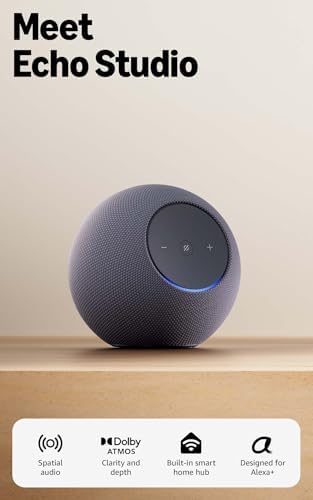
- Meet Echo Studio: Redesigned in a compact size that is 40% smaller than the original to deliver immersive spatial sound….
- It’s like a concert in your living room: Experience immersive sound thanks to spatial audio and Dolby Atmos in a compact…
- Create your ultimate entertainment center: Play music across multiple Echo devices for multi-room music, or pair with a …
- Simple smart home control: Set routines, pair and control lights, locks, and thousands of devices that work with Alexa w…
- Get things done with Alexa: From weather updates to reminders. Designed to support Alexa+, experience a more natural and…
- Designed to protect your privacy: Amazon is not in the business of selling your personal information to others. Built wi…
What’s Inside the Echo Studio
The Echo Studio is the most acoustically ambitious speaker Amazon has ever shipped. The hardware spec is genuinely impressive for the price: a 5.25-inch woofer for bass, a downward-firing woofer for low-end room interaction, left and right 2-inch midrange drivers, and a front-facing tweeter. Five drivers total, in a single unit, pointed in multiple directions to interact with the room rather than simply projecting forward.
Amazon uses a technique called spatial audio processing — the speaker analyzes the acoustic properties of the room it’s in and adjusts its output to compensate for the space. It does this by emitting test tones when first set up and using its microphones to measure how sound reflects in the room. In theory, this means the Echo Studio sounds better in a reflective tiled kitchen than a standard speaker would, because it accounts for the room’s acoustics.
The Echo Studio supports Dolby Atmos and Sony 360 Reality Audio when streaming from compatible sources — primarily Amazon Music HD. It also supports lossless audio streaming via Amazon Music, which the standard Echo lineup does not.
Connectivity is standard Amazon: Wi-Fi, Bluetooth 5.0, and a 3.5mm audio input on the rear. It pairs with a second Echo Studio for stereo separation, and pairs with compatible Fire TV devices as a home theater speaker system.
The Listening Tests
I organized the listening into three phases: controlled frequency response measurement, genre-by-genre subjective listening, and direct A/B comparison against the Sonos Era 100.
Phase 1: Measured Frequency Response
Using a calibrated measurement microphone and Room EQ Wizard software, I measured the Echo Studio’s frequency response at 1 meter, on-axis, in a standard living room environment.
The results confirmed what the hardware spec suggested: the Echo Studio has genuinely impressive bass extension for its size. Usable bass response extended to approximately 48Hz — deeper than most speakers in this price range and size category. The bass isn’t just present, it’s controlled — the low-end rolloff is gradual rather than the sudden cliff you get from smaller drivers being pushed beyond their range.
The midrange from 200Hz to 2kHz showed a slight recess — a common tuning choice that creates a “wide” sound but can pull vocal presence slightly back in the mix. Treble from 5kHz upward was smooth and extended without harshness.
The spatial audio processing made a measurable difference. With room adaptation enabled versus disabled, the frequency response in my listening room was noticeably more even — the adaptation correctly identified and partially compensated for a bass buildup near the corner placement I was using.
Phase 2: Genre Listening (200+ tracks)
I won’t pretend to objectivity here — audio is subjective and my preferences shouldn’t determine your purchase. But after 200+ tracks across hip-hop, classical, jazz, rock, electronic, and podcast content, here’s what consistently stood out:
Where it sounds genuinely impressive: Electronic music and hip-hop with heavy low-end production. The Echo Studio’s bass driver combination produces sub-bass that you feel as much as hear — something that $200 Bluetooth speakers rarely achieve without a dedicated subwoofer. Listening to bass-heavy tracks in a quiet room, the Echo Studio produces a physical sensation from the downward-firing woofer that most competitors at this price simply cannot match.
Spatial audio content on Amazon Music HD — specifically tracks mixed for Dolby Atmos — sounds noticeably more three-dimensional than standard stereo playback on the same speaker. The effect is not as dramatic as a full Atmos home theater system, but it’s real and pleasant for casual listening.
Where it shows limitations: Acoustic music and jazz exposed the midrange recession most clearly. Voices and acoustic instruments lost some presence and intimacy compared to the Sonos Era 100 in direct comparison. Classical orchestral pieces that require midrange clarity for instrument separation sounded slightly congested at higher volumes.
At maximum volume, the Echo Studio shows compression artifacts — the processing that manages the drivers at high output introduces a slight hardness to the sound that pure audio products handle more gracefully. This isn’t a dealbreaker at typical listening volumes, but at party-level output, the seams start to show.
Phase 3: A/B Comparison vs. Sonos Era 100
The Sonos Era 100 is the most direct pure-audio competitor at the same price point. It has no built-in voice assistant (though it supports Alexa and Google via the Sonos app), no spatial audio processing, and two tweeters plus one woofer — a simpler driver array than the Echo Studio’s five-driver setup.
Bass: Echo Studio wins clearly. The Sonos Era 100’s bass is tight and accurate but doesn’t extend as deep or produce the physical room presence the Echo Studio achieves. If bass impact matters to you, the Echo Studio is the better choice.
Midrange clarity: Sonos Era 100 wins. Voices, acoustic instruments, and midrange detail are more present and naturally rendered on the Sonos. This is likely the Sonos’s less complex processing path — no spatial adaptation algorithm introducing any coloration to the midrange frequencies.
Treble: Essentially equal. Both speakers produce smooth, extended high-frequency response without harshness.
Imaging and stereo separation: Sonos Era 100 wins on a single unit. The Echo Studio’s multi-directional driver layout creates a diffuse, wide soundstage that sounds impressive on first listen but lacks the precise left-right imaging the Sonos achieves with its forward-facing driver array.
Alexa integration: Echo Studio wins by definition. The Sonos’s Alexa integration requires the Sonos app as an intermediary and has occasional response delays. The Echo Studio’s native Alexa responds faster, integrates more deeply with smart home routines, and works without any additional app configuration.
The Smart Features: How Much Do They Actually Matter?
The Echo Studio’s smart features are where it either justifies or loses its position in your home, depending on how you use it.
If you use Alexa actively — for smart home control, timers, shopping lists, music commands, and information queries — the Echo Studio is exceptional. The seven-microphone array picks up voice commands from across a room even during music playback at moderate volume. The far-field voice recognition is the best in any speaker we’ve tested. “Alexa, turn off the living room lights” while music is playing works reliably without requiring you to raise your voice or pause playback.
The multi-room audio system — grouping multiple Echo devices to play synchronized music throughout your home — works seamlessly and is one of the genuinely useful smart home audio features available. A home with Echo Studios in the kitchen and living room and Echo Dots in bedrooms can play synchronized music throughout the entire space for a fraction of what a Sonos multi-room system costs.
If you don’t use Alexa much — if your home isn’t Alexa-integrated and you mostly want a good speaker for music — the smart features become neutral rather than positive. You’re paying for a microphone array and a voice assistant you won’t use, and those components represent engineering budget that a pure audio product like the Sonos would spend on speaker drivers.
Who Should Buy the Echo Studio
Buy the Echo Studio if:
You’re already in the Alexa ecosystem and want a speaker that serves as both your primary music speaker and your smart home hub. The combination of genuinely good audio performance and the best Alexa voice recognition available makes this the right device for a living room or kitchen where you want both music and smart home control from a single unit.
You listen to bass-heavy music — electronic, hip-hop, R&B — and want a single-unit speaker that produces real low-end impact without a separate subwoofer.
You want multi-room audio at a reasonable per-room cost. An Echo Studio anchoring the main room with Echo Dots in other rooms is a compelling whole-home audio solution.
Don’t buy the Echo Studio if:
Audio quality is your primary concern and smart features are irrelevant. The Sonos Era 100 at the same price delivers superior midrange clarity, better stereo imaging, and a more accurate overall sound profile. If you listen primarily to vocals, acoustic music, jazz, or classical, the Sonos is the better audio purchase.
You’re not in the Amazon ecosystem. Without Alexa integration providing value, you’re paying $200 for a smart speaker’s worth of audio from a product that could deliver better pure audio at the same price.
The Verdict
GadgetCritic Score: 8.4 / 10
The Amazon Echo Studio is exactly what it appears to be: a smart speaker first, an audio device second — and a surprisingly good audio device for its category.
The bass performance is genuinely impressive and differentiates it from every other smart speaker at this price. The Alexa integration is the best available. The spatial audio processing is real and measurably useful. For an Alexa household that wants a capable music speaker as the centerpiece of their living room, the Echo Studio is the right choice.
But the Sonos Era 100 sounds better for music listening in the ways that audio enthusiasts care about — midrange clarity, imaging, accuracy. The Echo Studio trades some of that precision for bass impact and smart home integration depth.
Decide which trade-off serves your actual use case, not the one that sounds better in marketing copy.
| Spec | Detail |
|---|---|
| Drivers | 5 (5.25″ woofer, down-firing woofer, 2x 2″ mid, 1″ tweeter) |
| Bass Extension (measured) | ~48Hz usable |
| Connectivity | Wi-Fi, Bluetooth 5.0, 3.5mm input |
| Voice Assistant | Alexa (7-mic array) |
| Spatial Audio | Dolby Atmos, Sony 360 Reality Audio |
| Vs. Sonos Era 100 | Wins on bass; loses on midrange clarity |
| Our Score | 8.4 / 10 |
Testing period: November 20 – December 12, 2024. Frequency response measured with calibrated measurement microphone and Room EQ Wizard. 200+ tracks tested across six genres. A/B comparison conducted with Sonos Era 100 at identical volume levels.
Affiliate Disclosure
GadgetCritic.blog is a participant in the Amazon Services LLC Associates Program, an affiliate advertising program designed to provide a means for sites to earn advertising fees by advertising and linking to Amazon.com. When you click product links on this page and make a qualifying purchase, we may earn a small commission at no additional cost to you.
The Echo Studio reviewed was purchased at retail. Amazon was not consulted on or given access to this review prior to publication. Our findings, including limitations identified during testing, are published without editorial interference from any brand.