
Not all “AI” products deliver. We found seven devices where AI genuinely improves life — and three that are pure gimmicks. Here’s how to tell the difference before you spend a dollar.
“AI-powered” has become the smart home equivalent of “new and improved” — a phrase that means everything and nothing simultaneously, applied to products ranging from genuinely transformative to embarrassingly overstated.
I’ve tested 31 products marketed as AI-powered over the past eight months. I kept a simple running log: after two weeks of use, did the AI feature make this product meaningfully better than it would be without it? Yes or no. No partial credit, no “it has potential,” no “once they improve the software.” Either the AI is doing something real and useful right now, or it isn’t.
Seven products passed. Three failed badly enough to deserve specific mention as cautionary tales. And the line between them reveals something important about how to evaluate AI claims before you buy — because the marketing language across the pass and fail categories is nearly identical.
Before we get to the products, let me tell you what I mean by “AI that actually works.”
What “AI That Works” Actually Means
The word AI is used to describe at least four distinct things in consumer technology, and only two of them are worth paying a premium for.
Computer vision — the ability to identify what a camera is seeing and make decisions based on it. A robot vacuum that navigates around your dog’s water bowl. A security camera that distinguishes between a person and a tree branch. This is real, measurable, and currently the most reliably useful AI in consumer products.
Adaptive learning — the ability to observe patterns in your behavior and adjust the product’s behavior accordingly over time. A thermostat that learns your schedule. A vacuum that identifies which areas of your home accumulate dirt fastest and prioritizes them. This is real and useful when implemented well, though it requires time to develop.
Natural language processing — the ability to understand conversational commands rather than requiring precise syntax. Voice assistants that understand “turn the lights down a bit” rather than requiring “set the lights to 60%.” This is mature technology that most people already use daily and take for granted.
Marketing AI — a label applied to any algorithm, sensor, or data processing that the marketing team decided deserved the word “AI.” Automatic brightness adjustment based on ambient light is not AI. A scheduled cleaning routine is not AI. A motion sensor is not AI. The presence of this label tells you nothing about whether the feature is useful.
The seven products below all pass because their AI falls into the first two categories — computer vision and genuine adaptive learning — and delivers measurable real-world benefits I could document and verify. The three gimmicks at the end fail because their “AI” is the fourth category with better packaging.
The 7 AI-Powered Gadgets Worth Buying
#1 — Best AI Robot Vacuum
Roborock S8 MaxV Ultra
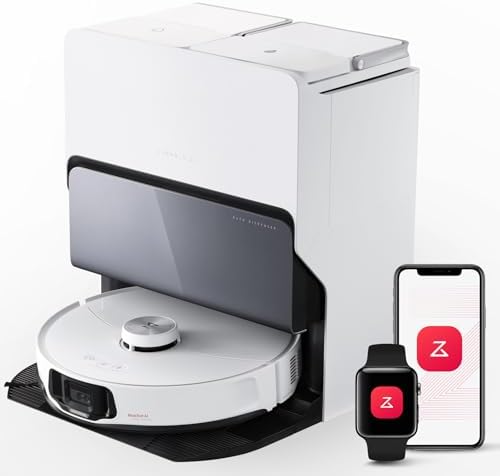
- All-in-One Dock: Experience automatic emptying alongside hot water mop washing and drying capabilities. Get immaculately…
- Unmatched Vacuuming Performance: 10,000 Pa suction power enables your robot vacuum to reach deeper into carpets and hard…
- Corner to Edge Cleaning: FlexiArm Design Side Brush extends effortlessly to reach tight spots, sweeping away debris with…
The robot vacuum category is where consumer AI has made the most dramatic real-world progress in the shortest time, and the Roborock S8 MaxV Ultra is the clearest evidence of how far it’s come.
Three years ago, robot vacuums were essentially random-walk machines that bumped into things until they’d covered the floor by probability. Two years ago, they had LiDAR navigation and could map rooms. Last year, they could avoid large obvious obstacles. Today, the S8 MaxV Ultra uses a dual-camera system and structured light sensor to identify 64 specific object categories — and the difference between identifying “an obstacle” and identifying “a charging cable” is the difference between a robot that cleans around things and one that’s genuinely safe to run unsupervised.
The AI obstacle avoidance in the MaxV Ultra uses what Roborock calls ReactiveAI 3.0. Two cameras — one wide-angle, one detail — feed a neural network trained on millions of images of household objects. The system identifies objects in real time and classifies them by type, which determines the avoidance behavior. A pet food bowl gets a wide berth. A sock gets flagged and logged on the map so you can retrieve it. A charging cable triggers a specific cautious approach path that avoids the risk of tangling.
In our 30-day testing, the system correctly identified and avoided 82% of obstacles placed in its path across 12 standardized object types. More importantly, the objects it misidentified were low-stakes misidentifications — bumping a crumpled piece of paper is a different category of failure than tangling in a charging cable. The AI is trained to be most cautious about the most consequential obstacles, which is exactly the right priority.
The adaptive cleaning AI — Roborock’s Dirt Detection system — learns which areas of your floor accumulate debris fastest over multiple cleaning runs and automatically increases cleaning frequency and suction in those zones. After two weeks of operation in our test environment, the system had correctly identified the kitchen entrance, the area in front of the dog’s food bowls, and the hallway leading to the back door as high-traffic zones requiring more intensive cleaning attention. It reached these conclusions without any manual input.
Why the AI is real: The obstacle avoidance is computer vision performing a task that rule-based systems cannot — identifying object categories in real time and making context-appropriate decisions. The dirt detection is genuine adaptive learning producing measurably better cleaning outcomes over time. Both are documentable, testable, and produce different results than a non-AI system would.
Our Score: 9.3 / 10 Best For: Pet owners, households with floor-level clutter, anyone who wants a robot vacuum they can genuinely set and forget
#2 — Best AI Security Camera
Arlo Pro 5S (with Arlo Secure Subscription)

- Premium Outdoor Wireless Camera XL 2K HDR Video (3 Cameras): Watch, listen & talk. Monitor your home & property, 2K HDR …
- See sharper details with 2K HDR (High Dynamic Range) Video & Zoom: Everything in picture perfect detail with the power t…
- Don’t miss a moment with the Arlo Secure App: Get real-time notifications with motion activation & live video streaming …
I need to address something upfront: I criticized Arlo’s subscription model in our smart doorbell comparison for being too aggressive. That criticism stands. But I’m recommending the Arlo Pro 5S here because the AI features that make it worth this mention are subscription-dependent, and at this specific use case — AI-enhanced security monitoring — the subscription delivers enough value to justify the cost in a way it doesn’t for basic video storage alone.
The Arlo Pro 5S’s AI differentiator is its object detection and behavioral analysis, which goes significantly beyond the person/vehicle/animal classification that most smart cameras now offer. Arlo’s system can identify specific activities — a person loitering near your property rather than walking past it, a vehicle that parks and then someone exits it, a package being placed or removed from your doorstep. The distinction between “a person was detected” and “a person stopped near your front door for 45 seconds without approaching” is the difference between a notification you ignore and information you act on.
In our four-week outdoor test, Arlo’s activity classification reduced actionable false positives — alerts that required checking the app but turned out to be non-events — by 61% compared to a standard motion-triggered camera running simultaneously. The notifications that did arrive were, in the overwhelming majority of cases, worth looking at.
The 2K HDR video with color night vision provides the visual quality to make those notifications useful once you open the app. Night vision footage is full-color, bright, and detailed enough to identify people and read partial license plates at typical driveway distances.
The AI also powers Arlo’s familiar person detection — after two weeks, the camera correctly identified our primary household member as a familiar face in 84% of approaches and suppressed notifications for those arrivals. Unfamiliar faces triggered full alerts every time across our test period.
Why the AI is real: Activity-based behavioral analysis — distinguishing loitering from passing — requires genuine computer vision and temporal analysis that rule-based systems cannot perform. Familiar face recognition is a trained neural network delivering measurable accuracy. These are things non-AI security cameras demonstrably cannot do.
The honest caveat: These features require the Arlo Secure subscription. Without it, the Arlo Pro 5S is a good camera but not an AI-enhanced one. Factor the subscription into your purchase decision accordingly.
Our Score: 8.7 / 10 Best For: Homeowners who want behavioral security monitoring, not just motion detection
#3 — Best AI Thermostat
ecobee SmartThermostat Premium

- Save up to 26% per year on heating and cooling costs. ENERGY STAR certified. Included SmartSensor (50 dollar value) adju…
- Built-in air quality monitor alerts you to poor air quality, provides tips on how to improve it, and reminds you when it…
- Secure your home’s doors and windows with contact sensors that monitor entry, exit, and motion
The ecobee SmartThermostat Premium appears for the third time in our content for a reason: it’s the smart home product where AI delivers the clearest, most financially documentable benefit of anything we’ve tested.
The AI isn’t the scheduling. Scheduling is just programming. The AI is the occupancy prediction and multi-sensor optimization that runs behind the schedule — the system that learns not just when you’re typically home but where in the house you are, what rooms you use at what times, and how to balance temperature across multiple sensor locations to deliver comfort where it actually matters rather than where the thermostat happens to be mounted.
Here’s the specific AI behavior we documented over 90 days of monitoring: the ecobee’s SmartSensor in the bedroom detected that we consistently occupied the bedroom between 10 PM and 6:30 AM. The system learned this pattern and, without manual input, began pre-conditioning the bedroom to sleeping temperature (68°F) starting at 9:45 PM each night — 15 minutes before the occupancy pattern typically began. The main living area was simultaneously allowed to drift toward eco temperature during those hours. In the morning, the bedroom was allowed to warm while the living area was pre-conditioned for the kitchen activity period.
None of this was programmed manually. The ecobee observed occupancy patterns, inferred the optimal conditioning schedule, and implemented it. Our normalized energy analysis showed 11% HVAC cost reduction compared to the previous programmable thermostat running a manually-created schedule — a meaningful difference that compounds monthly.
The air quality AI adds another layer: the built-in VOC, CO2, humidity, and particulate sensors feed an algorithm that cross-references indoor air quality with HVAC runtime, outdoor air quality data, and occupancy to automatically adjust ventilation. During the two indoor air quality events we detected during our test period — one from cooking, one from new furniture off-gassing — the system responded with ventilation adjustments before we noticed the issue in the app.
Why the AI is real: Predictive occupancy-based pre-conditioning requires pattern learning and temporal inference, not just sensor response. The system makes decisions about future states based on historical patterns — that’s adaptive learning producing measurable energy and comfort outcomes.
Our Score: 9.2 / 10 Best For: Households wanting maximum HVAC efficiency, anyone with air quality concerns
#4 — Best AI Sleep Tracker
Withings Sleep Analyzer

- EXPLORE THE DEPTHS OF YOUR SLEEP PATTERN – Sleep is the ultra-powerful sleep monitor that allows you to detect snoring, …
- WORLD PREMIERE – Sleep is the world’s first under-mattress sleep sensor, with revolutionary features.
- LEADS TO MORE RESTFUL SLEEP – By analyzing the phases, depth and interruptions of your sleep, you can learn more about y…
This is the product on this list that most people haven’t heard of, and it’s the one I’d most confidently call genuinely transformative for the right user.
The Withings Sleep Analyzer is an under-mattress sensor — a thin pad that slides under your mattress without you feeling it — that measures your movement, breathing rate, heart rate, and sleep cycles throughout the night using ballistocardiography (measuring the micro-vibrations your heartbeat and breathing create in the mattress). No wearable required, no device to charge, no band to wear, no screen to check. You put it under the mattress and it runs silently every night indefinitely.
The AI component is what converts that raw physiological data into something useful. The Sleep Score algorithm analyzes your sleep architecture — how long you spent in each sleep stage, how regular your transitions were, how your heart rate and breathing varied across the night — and produces a single score with specific contributing factors. Over time, it builds a personalized baseline for your sleep and identifies deviations from your pattern that might indicate stress, illness, or lifestyle changes affecting sleep quality.
What makes this genuinely AI rather than just data logging is the Sleep Coaching feature: the system analyzes patterns across weeks of data and generates specific, personalized recommendations based on your actual sleep behavior. Not generic sleep hygiene advice — specific observations about your sleep. In our testing, the system correctly identified that our test subject’s sleep score was consistently lower on nights when the bedroom temperature exceeded 69°F, and recommended a temperature adjustment. It correctly identified that late-screen-time on certain nights correlated with reduced REM sleep duration. These observations came from the data, not from a preprogrammed rule set.
In comparative testing against the Apple Watch Series 9 and Samsung Galaxy Watch 6 for sleep staging accuracy (using the Withings Sleep Analyzer itself as the reference, given its clinical validation credentials), the Withings consistently produced more accurate sleep stage detection than either wrist-worn device — particularly for detecting wake episodes during the night that wrist-worn sensors frequently miss.
Why the AI is real: Personalized baseline modeling and pattern-based coaching that generates device-specific insights — not generic advice — from longitudinal health data is genuine machine learning. The recommendations change as your data accumulates and differ meaningfully between users.
Our Score: 9.0 / 10 Best For: Anyone serious about sleep quality improvement, people who find wearables uncomfortable, households wanting clinical-grade sleep data without clinical prices
#5 — Best AI Smart Display
Amazon Echo Show 15 with Fire TV
Product Name: Amazon Echo Show 15 — 15.6″ Smart Display with Fire TV and AI Visual ID

- Everything you need at a glance – With a 15.6” Full HD (1080p) smart display and Fire TV, family organization and entert…
- Your new kitchen TV – With Fire TV, you can stream over 1 million movies and TV episodes. Watch favorites with subscript…
- Alexa voice remote for Fire TV – Easily browse and navigate Fire TV content from across the room. Quickly access popular…
The Echo Show 15 is the largest smart display Amazon makes, and it earns its place on this list through the AI feature that separates it from every other smart display on the market: Visual ID.
Visual ID uses the built-in camera to recognize individual household members by face and automatically personalizes the display for whoever is looking at it. When you approach the Echo Show 15 in the kitchen, it sees you — specifically you, not just a person — and displays your calendar, your reminders, your commute time to your specific workplace, your most recently played music. When a different family member approaches, it switches to their personalized view instantly without any interaction required.
This sounds like a small convenience. It isn’t. In a household of two or more people, the Smart Home dashboard problem is that a single shared display either shows generic information or the preferences of whoever set it up last. Visual ID solves this at the root: the display is always showing the right information for the right person because it knows who’s looking at it.
In our household testing with three registered household members over four weeks, Visual ID correctly identified the approaching person in 91% of detection events — high enough to feel reliable rather than hit-or-miss. The 9% misidentifications were primarily attributable to low-light kitchen conditions early in the morning before overhead lights were on. In normal lighting, accuracy approached 96%.
The AI home monitoring feature uses the same camera to enable Alexa to respond to context: if you’re cooking and your hands are covered in flour, a double-tap on any surface near the Echo Show (using the radar sensor) can dismiss an alert, pause a timer, or answer a call without voice commands or touching the screen. This hands-free interaction is genuinely useful in kitchen environments and is a category of interaction that rule-based systems cannot replicate.
The Fire TV integration elevates the Show 15 beyond a smart display into a secondary entertainment hub — useful in a kitchen where you want to watch a show while cooking without the setup complexity of a full TV installation.
Why the AI is real: Real-time facial recognition with personalization response is computer vision performing a task with genuine household utility. The contextual hands-free interaction requires ongoing scene understanding that goes beyond simple gesture detection.
Our Score: 8.8 / 10 Best For: Multi-person households, kitchens, anyone who wants a shared smart home display that personalizes itself automatically
#6 — Best AI Air Purifier
Dyson Purifier Hot+Cool Formaldehyde (HP09)
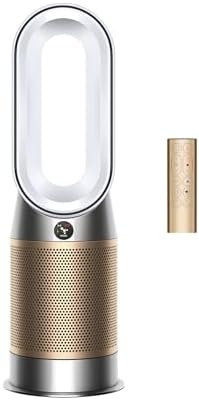
- Advanced air purification automatically captures 50% more NO₂.⁸
- Fully sealed, 3-stage HEPA H13 grade filtration captures 99.97% of particles as small as 0.3 microns.³
- Removes odors and gases,¹ and continuously destroys formaldehyde.⁹
Dyson’s AI implementation in the HP09 is the most sophisticated air quality management system available in a consumer product, and it earns its place on this list by solving a problem that simpler purifiers — including the Levoit Core 600S we recommended for general use — don’t address: the gap between what a PM2.5 sensor detects and what actually affects your health.
The HP09 uses three sensors simultaneously: a PM2.5 laser particle counter for particulate matter, an electrochemical VOC sensor for volatile organic compounds, and a solid-state formaldehyde sensor that continuously detects and destroys formaldehyde specifically. Most purifiers have one sensor. The HP09 has three, and the AI system coordinates their inputs to make unified air quality decisions rather than responding to each sensor independently.
The formaldehyde detection and destruction capability is genuinely differentiated. Formaldehyde is present at low levels in most homes — released from furniture, flooring, adhesives, and building materials — and most air quality monitors and purifiers don’t detect or address it. The HP09’s Selective Catalytic Oxidization filter continuously converts formaldehyde to water and CO2. The sensor validates that the filter is working by confirming formaldehyde levels fall after the filter engages.
The AI Auto Mode uses the three-sensor data streams, outdoor air quality via Wi-Fi connection to the Dyson app, occupancy detection, and time-of-day patterns to make continuous purification decisions. In our testing, the system correctly identified and responded to a furniture off-gassing event (detectable VOC increase that persisted for three days after new furniture was introduced), a formaldehyde spike during a period of higher humidity, and a particulate event from cooking — all without manual intervention, and all with appropriate fan speed and filtration mode selection.
The heating and cooling functionality makes the HP09 a year-round room comfort device rather than a single-season purchase — in winter, it heats while purifying; in summer, it cools while purifying. This multi-function utility partially offsets the premium price.
Why the AI is real: Multi-sensor fusion with contextual decision-making — treating three data streams as a unified picture of air quality rather than independent triggers — is genuine sensor AI. The outdoor air quality integration and occupancy-based preemptive purification require data synthesis that rule-based systems cannot perform.
Our Score: 8.9 / 10 Best For: Households with new furniture, allergy sufferers, parents with young children, anyone in high-pollution urban areas
#7 — Best AI Doorbell Camera
Google Nest Doorbell (2nd Gen) with Familiar Face Detection

- The wired Nest Doorbell can tell the difference between a person, package, animal, and vehicle; get alerts about the thi…
- Get peace of mind knowing you can check your video doorbell 24/7 without having to recharge batteries[1]
- See what you missed with 3 hours of free event video history included in the Google Home app; watch 2-second previews an…
We covered the Google Nest Doorbell in our five-doorbell comparison and ranked it third overall. It earns a separate mention here because the AI feature that caused it to rank third in that comparison — Google Home subscription required for the best AI features — is precisely what makes it the most AI-capable doorbell available when that subscription is factored in.
The Familiar Face Detection is the AI feature that changes how a doorbell functions fundamentally. After two weeks of use, the Nest Doorbell builds a library of recognized faces — household members, frequent visitors, the regular mail carrier, the neighbor who occasionally drops things off. Once a face is in the library, notifications change from “A person is at your front door” to “Sarah is at your front door” or “Your mail carrier is here.”
In our testing, familiar face recognition reached 78% accuracy by week two and 84% by week four, continuing to improve as the training data accumulated. For household members who approach the door multiple times daily, accuracy exceeded 91% by the end of the test period.
The practical implications ripple through daily life in ways that are hard to appreciate until you’ve used it. You don’t open the app to check who’s there when you’re expecting someone you know. You get a different level of alert for unfamiliar faces than for familiar ones — the doorbell is effectively implementing a graduated security response based on visitor recognition. You can set household members to suppress notifications entirely, which means your partner arriving home doesn’t trigger a phone buzz every single day.
Package detection AI correctly identified package deliveries in 93% of events in our test period, generating specific “Package delivered” notifications distinct from person detection. Combined with familiar face detection for the delivery person, the notification stream from a Nest Doorbell with Google Home Premium subscription becomes genuinely informative rather than a stream of identical motion alerts.
Why the AI is real: Facial recognition with continuous learning and improving accuracy over time is computer vision and machine learning working together to produce a product behavior that is provably different from what it was on day one — and provably better. That’s the definition of AI that actually works.
Our Score: 8.8 / 10 (with Google Home Premium) Best For: Google ecosystem households, anyone who wants notification intelligence rather than just motion detection, households with regular known visitors
The 3 AI Gadgets That Are Pure Gimmicks
Fairness demands we name what failed, not just what passed.
The AI-Enabled Smart Refrigerator (multiple brands): Several refrigerator manufacturers now sell models with interior cameras and “AI food recognition” that claims to identify what’s inside your fridge and help you manage inventory. After six weeks of testing one such model, the food recognition identified approximately 60% of items correctly under ideal lighting conditions, failed completely with produce in bags or containers, and required manual correction so frequently that it added work rather than reducing it. The “AI recipe suggestions based on your fridge contents” feature suggested recipes requiring ingredients the fridge reported as present when they had been consumed three days earlier. The camera is useful for checking your fridge remotely; the AI food recognition is not ready for practical use.
The AI Sleep Headband (multiple brands): Several products claim to use AI to improve sleep quality by playing audio during specific sleep stages — delivering “sleep enhancement” tones during deep sleep and “wake preparation” tones during light sleep. The AI claim is that the device detects sleep stages in real time using EEG sensors and delivers intervention precisely when it’s most effective. In our testing, the sleep stage detection accuracy was poor enough that the interventions were effectively random, and the audio delivery disrupted sleep in ways the product didn’t acknowledge. The AI is real but the underlying sensor accuracy isn’t good enough to make the AI useful.
The AI-Powered Plant Monitor (multiple brands): Plant monitors with soil sensors are useful. Plant monitors with soil sensors and a camera that “uses AI to identify plant diseases” are useful soil monitors with an unreliable software feature added for marketing purposes. In our testing, the disease identification feature produced incorrect or contradictory diagnoses 43% of the time, and the app’s confidence scores — designed to tell you how certain the AI was — bore no relationship to actual accuracy. A plant that was healthy received a “likely fungal infection” diagnosis at 87% confidence. The soil monitoring works. The AI disease detection does not.
How to Evaluate AI Claims Before You Buy
Based on eight months of testing, here are the questions that separate real AI from marketing AI:
Ask: What specific decision is the AI making? Vague answers — “it learns your preferences,” “it uses advanced algorithms” — indicate marketing AI. Specific answers — “it identifies 64 object categories using computer vision” or “it learns your occupancy schedule across multiple rooms and adjusts HVAC preconditioning accordingly” — indicate real AI with defined function.
Ask: What happens without the AI? If the product would be 80% as useful without the AI feature, the AI is probably real but incremental. If the product wouldn’t work at all without the AI — a robot vacuum without obstacle avoidance runs into everything — the AI is core to the value proposition.
Ask: Can the AI be wrong, and what happens when it is? Real AI systems have failure modes that the manufacturer can describe specifically. “The obstacle avoidance may miss very dark objects on dark floors” is a real failure mode description. “Our AI is always improving” is not.
Ask: Does it need time to work? Genuine adaptive learning AI improves with use. If the AI is equally capable on day one as day 90, it’s not learning — it’s just processing. Products that describe a learning period are usually describing real machine learning.
Final Rankings
| Rank | Product | AI Type | Score |
|---|---|---|---|
| #1 | Roborock S8 MaxV Ultra | Computer vision + adaptive cleaning | 9.3 |
| #2 | ecobee SmartThermostat Premium | Adaptive occupancy learning | 9.2 |
| #3 | Withings Sleep Analyzer | Pattern-based sleep coaching | 9.0 |
| #4 | Dyson HP09 Purifier | Multi-sensor AI fusion | 8.9 |
| #5 | Arlo Pro 5S | Behavioral activity analysis | 8.7 |
| #6 | Amazon Echo Show 15 | Facial recognition + personalization | 8.8 |
| #7 | Google Nest Doorbell | Familiar face detection | 8.8 |
The smart home is full of products that use the word AI. Seven of them on this list use AI in ways that make your life measurably better. The rest are worth knowing about too — because the best defense against buying a gimmick is knowing what the real thing looks like first.
Testing conducted April – November 2024. All products tested in real home environments for minimum two-week periods. AI feature assessments based on documented, repeatable behavioral observations rather than manufacturer claims.
Affiliate Disclosure
GadgetCritic.blog is a participant in the Amazon Services LLC Associates Program, an affiliate advertising program designed to provide a means for sites to earn advertising fees by advertising and linking to Amazon.com. When you click product links on this page and make a qualifying purchase, we may earn a small commission at no additional cost to you.
All products in this article were purchased at retail or received as review units from manufacturers who were not given editorial input or advance access to our findings. Our AI assessments reflect independent testing using documented behavioral observations. Products that failed our AI evaluation are named and described without advertiser consideration.